

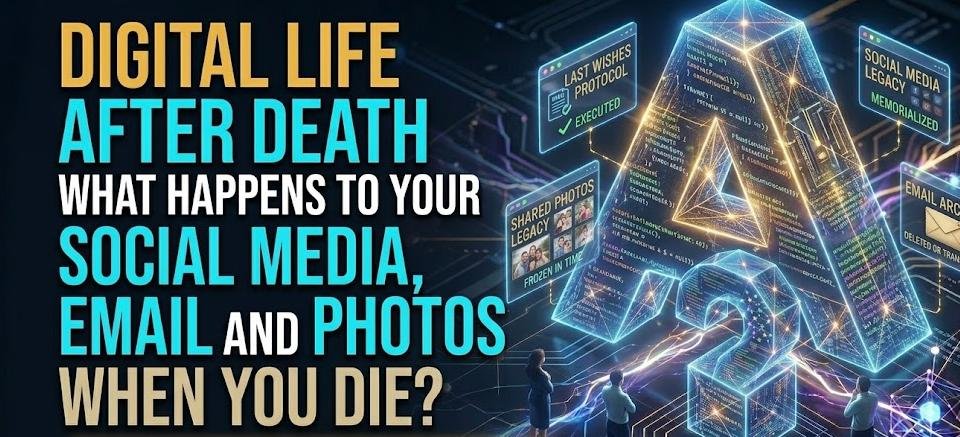
Digital Life After Death You plan everything in life. But nobody plans this.
Few months back something happened that really made me think.
My relative passed away. Very sudden. Nobody expected it.
After some days family started going through his things. His phone. His laptop. His accounts.
His Instagram was still active. His WhatsApp last seen was still showing. His Gmail was still getting emails. Birthday wishes from friends who did not know yet.
It felt very strange. Like he was still there. But he was not.
That day I thought — what actually happens to all this digital stuff when someone dies? Who controls it? Who can access it? What if nobody knows the passwords?
I spent two days reading about this. And honestly — what I found surprised me a lot.
So today let me tell you everything. Simple. Clear. Real.
Table of Contents
First — How Much Digital Stuff Do We Actually Leave Behind?
Think about your own phone right now.
Instagram. Facebook. WhatsApp. Gmail. Google Photos. YouTube. Snapchat. Maybe LinkedIn. Maybe some online banking apps.
Each of these has your photos. Your messages. Your memories. Your private conversations. Maybe even your money.
Oxford Internet Institute did a study and found that by end of this century the number of dead Facebook user accounts will reach nearly 5 billion. More than the number of living users. Gallup
5 billion dead accounts. More dead people than living people on Facebook.
That number hit me. Because it means all of us are building a massive digital life. And most of us have zero plan for what happens to it.
What Happens to Facebook When You Die?
Facebook is the most prepared platform for this honestly.
Facebook lets you set a Legacy Contact. This is one person you choose who can manage your profile after you die. They can write a pinned post like funeral details. They can update your profile picture. They can accept new friend requests.
But here is the important part.
Legacy Contact cannot read your private messages. Cannot remove your existing content. Cannot log into your account.
So your old chats? Your DMs? Your private photos? All locked. Even your chosen person cannot see them.
Your profile gets a “Remembering” badge. Content stays visible. But your profile stops showing in public searches or friend suggestions.
If family wants to delete account completely — they need to send death certificate and proof of relationship to Facebook.
My honest opinion — Facebook’s system is okay. But the DM and private message lock feels frustrating for families who just want to save memories.
What Happens to Instagram When You Die?
Instagram is owned by Meta. Same company as Facebook. But less options.
Your photos stay up. Account goes dark. No new stories. No activity. But there is no legacy contact feature as strong as Facebook’s.
Family member can contact Instagram to memorialize the account or fill a form to remove it. But nobody gets login access. Nobody can read messages.
So all those Instagram DMs — memories, conversations, private moments — all gone. Nobody can ever access them.
What Happens to Gmail and Google Photos?
This one is very important. Because Google holds so much of our life.
Emails. Photos. Google Drive files. YouTube videos. All in one account.
Google has something called Inactive Account Manager. You can set it up yourself in advance. You choose how long Google should wait — 3 months to 18 months of inactivity. After that Google contacts you. If no response — Google follows your instructions. You can choose up to 10 trusted contacts to receive specific data. You can even pre-write emails to be sent after your death.
That last part honestly — writing emails to be sent after you die — sounds like a movie scene. But it is real.
If you never set up Inactive Account Manager — family has to submit request with death certificate, government ID, and proof of relationship. And even then Google may not give full access. Google will never share your password.
Also very important — Google deletes accounts that are inactive for two years. So if nobody takes action — all your Gmail, all your Google Photos, all your Drive files — gone forever automatically.
This scared me honestly. All my photos. All my emails. Just deleted because nobody acted in time.
What Happens to WhatsApp?
WhatsApp has no death policy. No legacy contact. No memorial option.
If nobody knows your password and phone is locked — those messages are gone. Forever.
All those family conversations. Old voice notes. Precious memories. Locked inside a phone nobody can open.
This is the one that hurts most I think. Because in India especially — WhatsApp is where so much of our real life conversations happen.

What Happens to Snapchat and TikTok?
Snapchat will only delete an account if request comes from the email connected to that Snapchat account. They do not allow anyone else access. No memorial option at all.
TikTok also has no memorial option. Family can request removal but account cannot be reactivated once deleted.
Both platforms basically act like — this account belongs to one person only. When that person is gone, account goes too. No family access. Nothing.
What Happens to Your Photos Stored in Cloud?
Without clear plan, private photos and letters stored in cloud may be lost forever.
48% of people have zero instructions in place for their digital assets. Families face legal problems and emotional stress trying to access accounts.
Almost half of people. No plan. Nothing written down. Just hoping family figures it out somehow.
And it is harder than people think.
Most modern accounts use Two Factor Authentication. So even if family has your password — they still need your phone to get the verification code. Without that phone — they are locked out completely.
So password alone is not enough anymore. Your phone is needed too. And if phone is locked with fingerprint or face ID — that is gone the moment you are gone.
What Happens to Your YouTube Channel?
If you have a YouTube channel with subscribers and money — this is a big deal.
YouTube is where things get financially interesting. Google allows family members to request account closure or downloading of content through Inactive Account Manager.
But monetization? Revenue? Channel ownership? Very complicated to transfer. Family needs legal authority. Death certificate. Long process.
If you make money from YouTube — and most people never think about this — what happens to that income after you die?
My Honest Opinion on All This
I think about my own accounts now.
Thousands of photos in Google Photos. Years of conversations in WhatsApp and Instagram DMs. Emails going back many years. Files in Google Drive.
If something happened to me tomorrow — my family would struggle to access any of it. Because I never set up anything. Never wrote anything down. Never thought about it.
And that feels wrong.
Not because I am scared of dying. But because these memories belong to the people I love too. My photos are not just my photos. They are family memories. And locking them away forever just because nobody has the password — that does not feel right.
What Should You Do Right Now?
Simple steps. Do not overthink. Just start.
Set up Facebook Legacy Contact. Go to Settings → Account Center → Personal Details → Account Ownership and Control → Memorialization. Takes 2 minutes.
Set up Google Inactive Account Manager. Go to myaccount.google.com → Data and Privacy → More options → Make a plan for your Digital Legacy. Choose trusted contacts. Choose what data they get.
Set up Apple Legacy Contact. Go to Settings → Your Name → Password and Security → Legacy Contact. Add someone. They get an access key.
Write your passwords somewhere safe. A physical notebook kept in safe place. Or a trusted password manager with one trusted person knowing the master password.
Tell someone. Just one trusted person. Tell them where your passwords are. Tell them what you want done with your accounts.
Google and Apple accounts are most important. They hold recovery information for almost all other accounts. Start there.
Conclusion
My relative’s Instagram is still active. Sometimes his old posts still show up in memories. Friends still tag him sometimes not knowing what to do.
It is not bad. But it is also not planned. Nobody knew what he would have wanted.
Most of us will leave no digital plan and create a quiet personal chaos — passwords nobody knows, accounts nobody can access, photos floating on servers nobody can reach.
We plan so many things in life. Insurance. Bank accounts. Property.
But our digital life? Most people never think about it even once.
Just spend 30 minutes this week. Set up legacy contacts. Write your passwords somewhere safe. Tell one trusted person.
Your photos. Your memories. Your conversations. The people you love deserve to keep them.
Do not leave them locked behind a password nobody knows.
Have you ever thought about what happens to your accounts after you die? Tell me in comments. I think most people never think about this. But maybe after reading this — you will. 😄
